
Audi and SAIC have moved their China-only electric brand out of the project phase and into something much more serious: its own 300-person development operation in Shanghai. The new AUDI Innovation & Technology Center, or AITC, will develop four China-exclusive models on the next-generation ADP 2.0 architecture. The first car from that second wave is due in 2028.

That capitalisation matters. AUDI is the China-market sister brand created by Audi and SAIC, with a four-letter wordmark on the nose instead of the four rings. It is not a typographical shout, and it is not the global four-ring Audi range under a new font. The two share engineering DNA, but AUDI is being built around Chinese buyers, Chinese digital services and a much faster local product cycle.
A real Shanghai R&D centre, not another liaison office
AITC is a joint venture with whole-vehicle and end-to-end development capability. Its brief runs from vehicle performance and driving dynamics to immersive AI-powered cabins and next-generation driver-assistance systems. It will also work on software-defined and AI-defined vehicles. In plain English, Audi and SAIC want the Shanghai team to engineer the car and the digital experience together, rather than bolt locally popular software onto a finished German platform.
About 300 people will staff the centre. Audi appointed Matthias Pfister as general manager, with SAIC appointing Shan Yunwei as deputy general manager. Pfister previously led SAIC Volkswagen’s Shanghai Pre-Series Center. Fred Schulze, who became CEO of the Audi-SAIC cooperation on July 1, is chairman of AITC.
This is the follow-through to the strategic agreement Audi and SAIC announced in April. Back then the centre was something they planned to establish. On September 3 it became an operating entity, with named management, a team and a defined product programme.
Four cars, one new ADP 2.0 backbone
The four new models will use ADP 2.0, short for Advanced Digitized Platform 2.0. Audi describes it as an architecture for the next generation of intelligent connected vehicles. None of the four cars has been named, and Audi has not published body styles, battery specifications, prices or production volumes. The only firm product timing in the same-day reporting is that the first is scheduled for 2028.

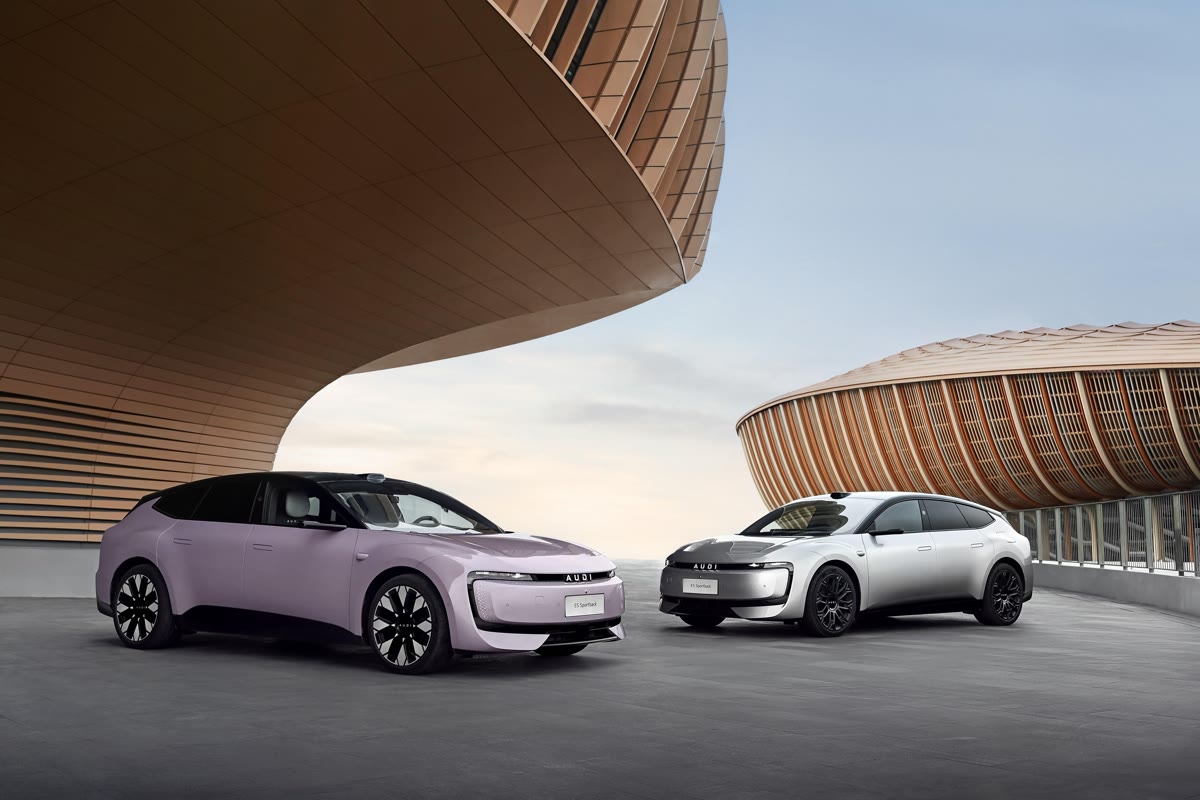
These are additional cars, not replacements for the first AUDI products. The original ADP programme started with the E5 Sportback in 2025. The E7X followed as the sister brand’s first SUV in 2026, while a third first-wave model is scheduled for 2027. The ADP 2.0 quartet beginning in 2028 is the expansion phase.
That distinction also explains why an E5 or E7X photograph is relevant here but should not be labelled as one of the four new models. Audi has released no verified image of an unnamed ADP 2.0 car. The existing cars show the brand AITC is being created to extend; they do not preview a design Audi has not shown.
Why Audi needs the local speed
China’s premium EV fight is not waiting for the traditional European model cycle. Cabin software, driver assistance and connected services can move as quickly as horsepower and range. Audi’s answer is to put vehicle engineers beside SAIC’s local digital and supply-chain expertise, then give that team responsibility across the car instead of only a market adaptation.

The E7X shows the direction. Its China-specific equipment includes an AI-powered assistant, a 21.4-inch rear entertainment display and a lidar-based assistance system developed for local traffic conditions. AITC’s job is not to keep that recipe frozen until 2028. It is to create the next architecture and four more products while Chinese competitors keep raising expectations.
The four rings are not disappearing
AUDI sits alongside four-ring Audi in China, not on top of it. The sister brand targets customers who want a locally shaped intelligent EV, while the familiar Audi badge continues across its own China portfolio. Calling AITC an Audi R&D centre is broadly true; calling the four planned cars new four-ring Audis would be wrong.
For now, the big news is not a mystery model or a speculative silhouette. It is the infrastructure behind the next four cars. Audi and SAIC have attached roughly 300 people, a Shanghai headquarters and a 2028 deadline to ADP 2.0. That gives the all-caps experiment a longer runway—and makes AUDI look less like a side project than a second, distinctly Chinese product machine.
Sources: CnEVPost, September 3, 2026; Reuters via Euronext, September 3, 2026; Audi’s April 17 partnership background; Audi E7X official background; Audi leadership announcement.